What Causes Trailer Sway, and What Actually Fails at the Hitch Near Tavares
A boat trailer that starts to wander behind you on US 441 is not a handling quirk, and it rarely settles down on its own. Tavares sits in the middle of the Harris Chain, with public ramps at Wooton Park on Lake Dora and a weekend stream of boats and campers moving along State Road 19. The trips that go wrong usually go wrong one of two ways: the trailer begins to sway at speed and the driver's first instinct makes it worse, or the connection at the ball lets go. The two failures are closer relatives than they look.
Trailer Sway Starts With Weight in the Wrong Place
Trailer sway is a side-to-side oscillation that feeds on itself, and it almost always begins with too little weight pressing down on the hitch. A properly loaded trailer pushes the ball down hard enough that the tow vehicle's rear axle keeps the combination straight. Take that away and the trailer pivots freely around the ball, so every gust and steering correction adds energy instead of bleeding it off.
The number behind that is tongue weight, and for boat trailers it is smaller than most people guess. Connecticut's Department of Energy and Environmental Protection states that only 5 to 7 percent of the total trailer weight should be on the hitch, and that too little tongue weight will cause the trailer to fishtail. California's Division of Boating and Waterways describes the same mechanism: too little, or negative, weight on the hitch will cause the trailer to sway or fishtail.
Why the Load Behind the Axle Is Usually the Culprit
Weight moved behind the trailer axle is what strips tongue weight away. A cooler and two batteries dropped in the stern of a boat, a full livewell, or gear stacked at the back of a utility trailer all shift the balance point rearward. The axle is a fulcrum, so a hundred pounds moved three feet aft takes far more than that off the ball.
The fix is usually repositioning, not hardware: move heavy items forward of the axle, strap them down, and confirm the trailer sits level or slightly nose-down. For heavier rigs, the California guidance recommends heavy-duty equalizing hitches for tongue weights of 250 pounds or greater, a threshold a loaded bass boat clears easily.
What to Check Before You Pull Out of the Driveway
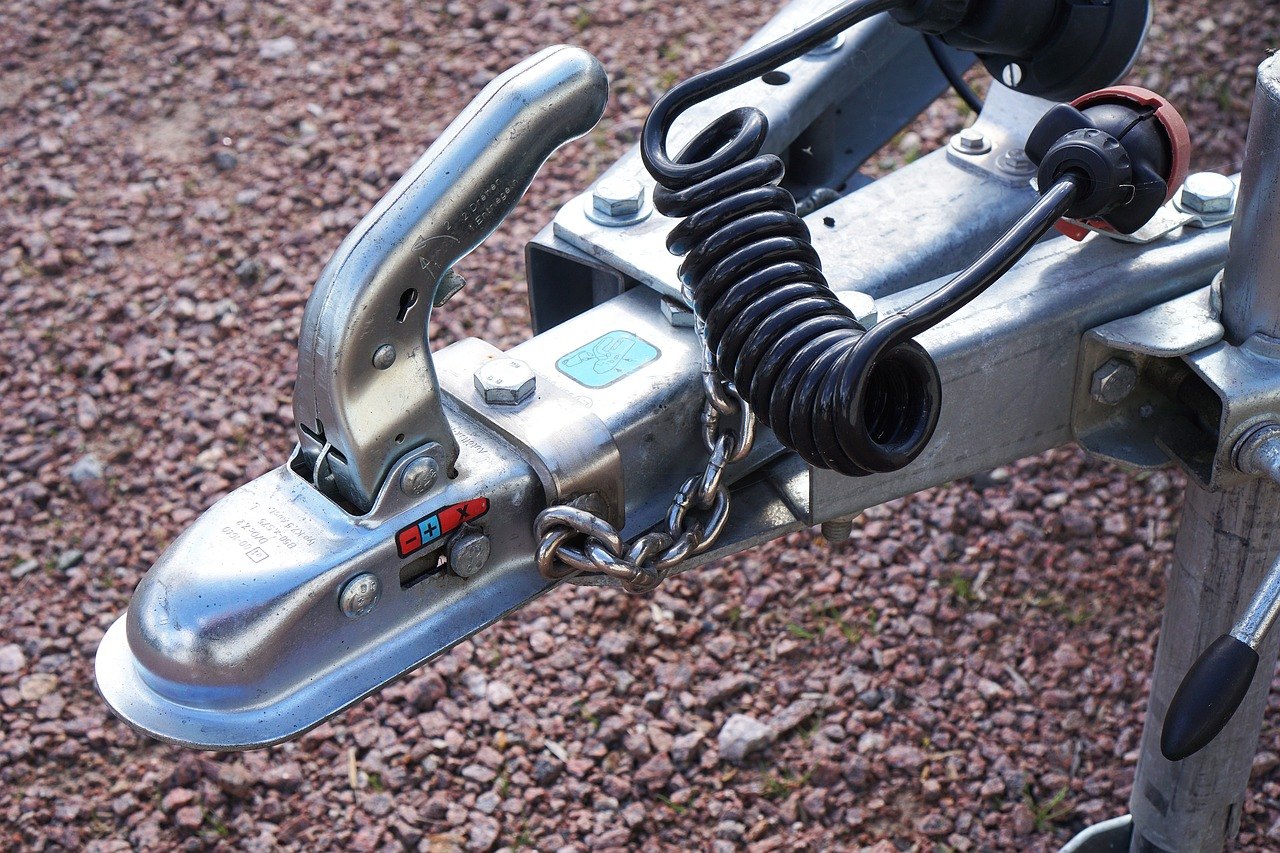
- Coupler fully seated on the ball, latch closed, and a pin through the latch.
- Ball size stamped on the coupler matches the ball on the hitch, not merely close to it.
- Safety chains crossed in an X under the tongue, attached separately from the ball mount.
- Breakaway cable anchored to the tow vehicle's frame, never clipped to a safety chain.
- Heavy gear forward of the trailer axle and strapped so it stays there.
- Trailer sitting level or slightly nose-down once loaded.
- A repeat check of hitch and chains after the first few miles.
If the trailer starts swaying, do not grab the brakes and do not try to steer out of it. Hard braking pushes the trailer against a connection that is already moving, and steering corrections feed the oscillation. Ease off the throttle and hold the wheel straight.
Trailer swaying, or sitting sideways on 441 with the chains still attached? Tell a dispatcher what the rig is and where it stopped, and the right truck can be rolling while you get clear of the lane.
Call Now (352) 517-5260What to Do the Moment a Trailer Starts to Sway
The correct response is to remove energy from the system and change nothing else. Lift off the accelerator smoothly, keep both hands on the wheel and hold your lane. Sway is speed-dependent, so even a modest drop in speed often ends it within seconds. If the trailer has an electric brake controller with a manual lever, the trailer brakes alone pull the combination straight from behind, the one braking input that helps.
Almost everything else makes it worse. Stabbing the tow vehicle's brakes transfers weight forward, unloads the rear axle and gives the trailer more room to pivot, and countersteering adds a fresh input roughly as often as the oscillation already runs.
Once stopped, treat it as a diagnosis rather than a scare. Sway on a trailer that towed fine last month means something changed: the load, the tire pressures, the hitch height, or a worn coupler.
Couplers and Balls Fail in a Few Predictable Ways
Nearly every coupler separation traces back to one of four causes. The first is a coupler never fully seated: the latch closes over the top of the ball rather than under it, and the first real bump lifts the tongue clear. The second is a size mismatch, usually a 1-7/8 inch coupler dropped onto a 2 inch ball, which sits loose enough to climb off under load. The third is an unpinned latch, which vibrates open over enough miles of SR 19.
The fourth is wear. A coupler socket hammered by years of launches spreads, and a worn ball loses diameter, so the two develop play. That play is itself a sway source, which is why a rig can start wandering and separate on the same trip. Seat the coupler, close the latch, pin it, then lift the tongue by hand with the jack retracted. If it rises off the ball, it is not connected.
Chains and Breakaway Brakes Are Florida Law, and They Are the Backup Plan
Safety chains are a legal requirement in Florida, and they decide how a separation ends. Florida Statute 316.530 requires a trailer towed by a rear trailer hitch to be attached by safety chains, cables or other safety devices that comply with 49 C.F.R. subpart F and are of sufficient strength to maintain connection under all conditions, with fifth-wheel hitches exempted. Crossing them in an X beneath the tongue is what makes them work: crossed chains prevent the tongue from digging into the pavement and flipping the trailer over.
Brakes are the other half. Florida Statute 316.261 requires trailers over 3,000 pounds gross weight to have brakes on all wheels, applied automatically and promptly on breakaway and remaining applied for at least 15 minutes. Lighter trailers can be exempt only where the weight on the trailer's wheels stays under 40 percent of the towing vehicle's gross weight. That 15-minute figure is the whole design intent of a breakaway cable, and clipping that cable to a safety chain defeats it: the chain stays attached and the pin never pulls.
A Weight-Distribution Hitch Changes Geometry, Not Total Weight
A weight-distribution hitch moves load back onto the tow vehicle's front axle and the trailer axles; it does not make anything lighter. Spring bars run from the hitch head to brackets on the trailer frame and apply leverage that levels the combination, restoring steering and braking authority at the front wheels.
What it cannot do is rescue a badly loaded trailer. If the gear sits behind the axle and tongue weight is near zero, the bars have little to work against. Weight distribution is also distinct from friction or dual-cam sway control, which damps oscillation rather than redistributing load. Bars at the wrong tension, loose brackets or a hitch head angled wrong change how a trailer behaves without warning.
Where Trailers Come Apart Around Tavares
Lake County gives trailer problems a few specific places to surface, and the road shapes the recovery. State Road 19 joins US 441 in Tavares and overlaps it for roughly 3.27 miles northeast to South Bay Street in Eustis, merge-heavy traffic where a swaying trailer has nowhere wide to go. West of downtown, US 441 and SR 44 squeeze between Lake Harris and Lake Eustis as a six-lane divided highway and cross the Dead River on a bridge, which offers no shoulder at all. South of town, SR 19 crosses Little Lake Harris toward Howey-in-the-Hills, the direct line from the Wooton Park ramps, and north of Eustis it runs close to 22 miles through Umatilla and Altoona into the Ocala National Forest.
That geography is why a separated or badly swayed trailer is a recovery job, not a roadside repair: a trailer across a lane with a bent tongue or a boat shifted off its bunks cannot be re-hitched and driven away. Depending on the weight, that is roadside assistance, a medium-duty tow, or heavy-duty equipment. If the rig has left the pavement into soft sand, it is a winch-out recovery first and a tow second.
Sway, Couplers and Chains: Straight Answers for Lake County Drivers
Can trailer sway happen below highway speed?
Yes, but it is less common and usually milder. The oscillation needs energy to build, which is why most episodes start above roughly 45 to 50 miles an hour. A trailer that wanders at low speed around Tavares is telling you the loading, a tire or the coupler is already wrong.
Is a swaying trailer safe to drive the rest of the way home?
Not until you find the cause. Sway is a symptom of a load balanced too far back, low tongue weight, a soft trailer tire, or play in a worn coupler. Pull off where there is room, re-check the load and the hitch, and continue only if you fixed something specific.
What happens if my trailer comes off the ball on US 441?
Properly crossed safety chains should catch the tongue and keep it off the pavement, and a working breakaway cable should apply the trailer brakes so it stops itself. Expect damage to the tongue, coupler or chains. Get well clear of the travel lane before assessing anything.
Does a boat trailer need its own brakes in Florida?
It depends on weight. Florida requires brakes on all wheels for trailers over 3,000 pounds gross weight, exempting lighter trailers only where the weight on the trailer's wheels stays under 40 percent of the tow vehicle's gross weight. A loaded boat, trailer and fuel reach 3,000 pounds faster than most owners expect.
Trailer Off the Ball, or Across a Lane?
Tell us what you are towing, whether the trailer is still on its wheels, and where it stopped between Tavares and the forest. We will send equipment sized for the load instead of a truck that has to turn around.
Call Now (352) 517-5260